
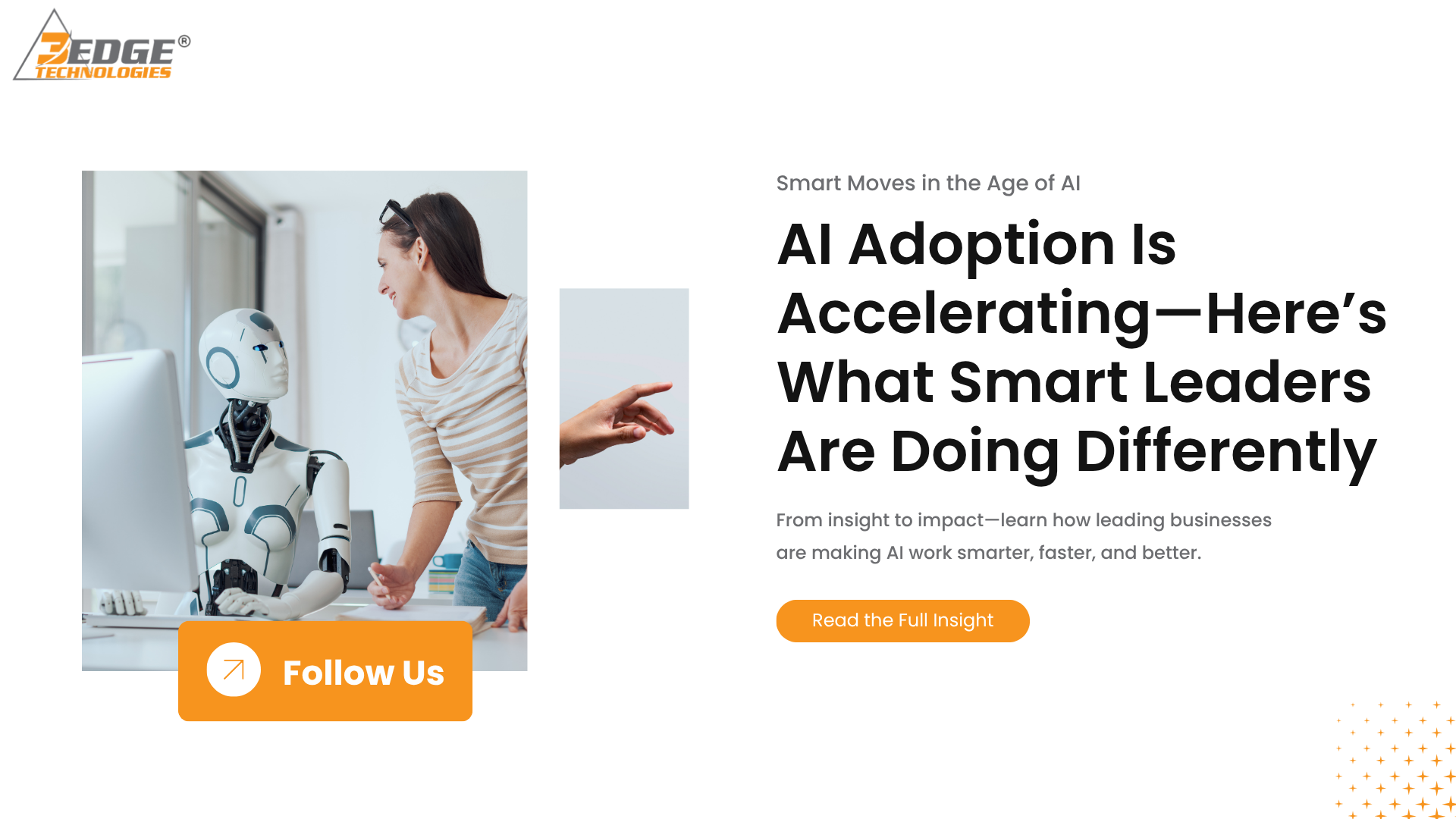
The pace of change driven by artificial intelligence is unlike anything we’ve seen before. From automating mundane processes to unlocking strategic insights, AI is reshaping industries at an astonishing rate. For business leaders, this wave of AI adoption isn’t just another trend—it’s a transformative shift demanding a proactive strategy. But while many are jumping on the AI bandwagon, only a few are truly leveraging its potential. These outliers are thinking differently, acting decisively, and shaping the future.
In this blog, we’ll explore the key ways in which successful leaders are embracing AI adoption. We’ll examine critical mindsets, proven tactics, and forward-looking strategies that separate the innovators from the imitators. Whether you’re looking to lead digital transformation, future-proof your operations, or boost decision-making with AI, this comprehensive guide will show you how. Let’s dive in. Explore 3Edge Technologies’ AI services here.
What to Know Before Driving AI Transformation in Your Organization
Before diving into implementation, smart leaders lay the groundwork for meaningful AI transformation. Understanding the nuances of AI integration, its organizational implications, and long-term ROI is essential. Let’s look at some foundational insights leaders must internalize before building their AI roadmaps.
Understand the Difference Between AI Hype and Practical ROI
The world of AI is filled with buzzwords and lofty promises, but not every tool delivers tangible value. Savvy leaders cut through the hype to evaluate AI projects based on real business outcomes. Focusing on practical AI adoption use cases—like improving customer support with NLP or enhancing supply chain visibility with predictive analytics—ensures every investment is ROI-driven.
Learn more about practical AI ROI from Harvard Business Review.
Additionally, measuring success goes beyond initial deployment. Leaders track KPIs over time, assessing how AI impacts efficiency, accuracy, or revenue. This critical evaluation mindset distinguishes smart leaders from those who adopt AI blindly.
They also learn to distinguish between solutions that sound advanced and those that actually integrate seamlessly into current operations. A dashboard that looks intelligent but is difficult to implement or scale will eventually lead to stalled innovation. Prioritizing feasibility, usability, and results makes all the difference.
Assess AI Readiness Across People, Processes, and Technology
Before rolling out AI solutions, companies need to assess internal readiness. Do your teams understand data-driven decision-making? Are your systems capable of supporting machine learning models? Answering these questions helps identify capability gaps.
Equally important is change management. Leaders must cultivate a culture that embraces innovation, fosters experimentation, and supports upskilling. Successful AI adoption is just as much about people and processes as it is about algorithms.
It’s essential to conduct readiness audits involving stakeholders from various departments. These cross-functional insights help in tailoring AI solutions to actual business needs. Aligning readiness assessments with long-term goals creates a smoother path to transformation.
Build an Ethical and Transparent AI Adoption Framework
Trust is a cornerstone of long-term AI adoption. Smart leaders prioritize ethical guidelines to ensure their AI systems are fair, accountable, and explainable. This involves establishing governance protocols for data use, bias detection, and result interpretation.
Transparency isn’t just good ethics—it’s good business. As consumers and regulators become more AI-literate, organizations must be able to clearly explain how and why AI-driven decisions are made. It builds credibility and future-proofs compliance.
Explore guidelines for Responsible AI by the OECD.
Moreover, ethical frameworks are crucial in sensitive sectors such as healthcare, finance, and recruitment. Clear documentation, audit trails, and open communication ensure that AI adoption doesn’t compromise brand integrity or stakeholder trust.
Create a Scalable Data Infrastructure for Successful AI Adoption
No AI system can thrive without quality data. Leaders who excel in AI adoption invest early in scalable, clean, and accessible data infrastructures. This includes secure data pipelines, integrated storage, and real-time analytics platforms.
More importantly, they promote data democratization. By empowering cross-functional teams with access to data tools, organizations can maximize AI innovation at every level—from operations to marketing.
A well-structured data foundation also prevents bottlenecks during AI training and deployment. It ensures that as demands grow, the system can scale without compromising performance or insight accuracy.
Align AI Projects with Strategic Business Objectives
Effective AI deployment isn’t a side project—it’s tightly aligned with business goals. Smart leaders don’t chase shiny objects; they define clear outcomes first, then select AI solutions that directly support them. Whether it’s increasing customer retention or optimizing resource allocation, every AI initiative is part of a broader value strategy.
Strategic alignment also fosters stakeholder buy-in. When executives, IT leaders, and business units see the connection between AI adoption and organizational success, adoption accelerates organically.
Read more about strategic alignment in AI on MIT Sloan Management Review.
Continuous alignment reviews help maintain focus as market conditions evolve. Leaders revisit goals, tweak models, and refine metrics to ensure consistent relevance and value delivery.
Top Actions Smart Leaders Are Taking to Maximize AI Adoption
To unlock AI’s full potential, today’s top leaders are taking bold steps and making deliberate choices. Here are some of the most effective strategies they’re using to outpace the competition.
1. Appointing Dedicated AI Leadership Roles
Progressive organizations are creating C-suite roles such as Chief AI Officer or AI Program Director. These roles bridge the gap between technical teams and executive decision-makers, ensuring AI adoption remains aligned with strategic priorities.
Beyond titles, they empower leadership with authority, budget, and responsibility. This clear ownership drives accountability and speeds up decision-making around AI projects.
These roles also facilitate collaboration with data science teams, ensuring that projects are driven not only by innovation but also by strategic needs and measurable outcomes.
2. Prioritizing High-Impact AI Use Cases First
Rather than attempting broad transformation, effective leaders start small but strategic. They target high-impact use cases—such as fraud detection in finance or personalized product recommendations in retail—to quickly demonstrate AI’s value.
This focused approach builds momentum, proves feasibility, and generates internal support for scaling efforts. It’s a classic “think big, start small, scale fast” mindset.
For use case examples, visit Gartner AI Use Cases.
Additionally, early wins provide a framework for broader adoption. Leaders use them as proof points to secure further investment and expand AI projects across new verticals.
3. Partnering With External AI Experts for Scalable Adoption
Smart leaders understand they don’t have to build everything in-house. They collaborate with AI consultancies, technology providers, and startups to access specialized knowledge and accelerate time to value.
These partnerships also help navigate technical complexity and regulatory compliance, allowing internal teams to focus on core business transformation.
Engaging with external experts provides a fresh perspective and helps avoid tunnel vision. It also ensures that AI projects benefit from global best practices and cutting-edge innovations.
4. Fostering a Culture of AI Experimentation
Fear of failure can stall AI initiatives. Top-performing leaders counter this by fostering a culture of experimentation. They create sandboxes, run pilots, and celebrate learning as much as success.
This innovation mindset encourages teams to explore new AI applications without fear, ultimately leading to faster discoveries and deeper insights across the organization.
Organizational encouragement for trial and error builds psychological safety, empowering employees to engage deeply with AI and take informed risks that lead to breakthroughs.
5. Upskilling the Workforce for AI-Driven Operations
AI doesn’t replace people—it augments them. Successful leaders invest in workforce development to ensure employees can collaborate effectively with AI tools.
From offering machine learning workshops to promoting AI literacy across departments, they build an inclusive AI ecosystem that taps into both human and machine intelligence.
This dual capability leads to smarter operations and better outcomes. Upskilled employees feel more secure and motivated, driving broader AI adoption and success.
Why Choose 3Edge Technologies to Drive AI Transformation
3Edge Technologies empowers enterprises to seamlessly integrate AI into their digital strategies. With a proven track record in intelligent automation, data engineering, and custom AI development, we bring both technical depth and strategic insight. Our solutions are designed to drive real business value—not just hype.
From roadmap consulting and pilot implementation to full-scale AI deployment, 3Edge is your trusted partner in achieving AI excellence. We focus on ethical, scalable, and ROI-driven AI adoption that aligns with your long-term goals. Learn more about our AI services.
Conclusion
AI adoption is no longer a futuristic concept—it’s a present-day imperative. But the difference between leaders who succeed and those who struggle lies in their approach. Smart leaders aren’t just using AI; they’re transforming their cultures, rethinking their strategies, and building ecosystems that can scale innovation.
By learning from these pioneers and taking actionable steps, your organization can thrive in the AI era. Let 3Edge Technologies be the partner that gets you there. Embrace change, lead boldly, and position your business for sustained success in the intelligent future.
FAQs
What is AI adoption in business?
AI adoption in business refers to integrating artificial intelligence technologies into operations to enhance efficiency, decision-making, and innovation.
Why is AI adoption accelerating now?
Advancements in computing power, cloud infrastructure, and data availability have made AI more accessible and affordable, driving faster adoption.
How can companies assess AI readiness?
By evaluating infrastructure, employee skillsets, data quality, and organizational willingness to adapt to change.
What are common use cases for AI in enterprises?
Examples include predictive maintenance, chatbots, fraud detection, customer segmentation, and supply chain optimization.
What are the challenges in AI adoption?
Challenges include data silos, lack of skilled talent, resistance to change, and unclear ROI.
How do leaders prioritize AI projects?
They align initiatives with business goals, assess potential impact, and start with small, high-return projects.
What is ethical AI, and why does it matter?
Ethical AI ensures fairness, transparency, and accountability in AI systems, building trust with users and stakeholders.
How important is data in AI strategy?
Extremely important—data is the foundation of AI. Clean, accessible, and well-structured data fuels accurate models.
Should businesses build AI in-house or outsource?
It depends on capabilities and goals. Many successful firms partner with AI experts to speed up implementation.
How can 3Edge Technologies help with AI adoption?
3Edge provides end-to-end AI services—from strategy to implementation—tailored to drive real-world business outcomes.
